Command and Control: The Hidden Capital Consequence of Europe's AI Sovereignty Rupture
Germany has now rejected Palantir outright for two major national programmes. That is no longer sentiment, it is procurement fact, and it resets the entire investment case.
The sovereign AI story has moved from policy signal to binding decision. Germany's Bundeswehr excluded Palantir from its federal cloud-and-AI project in April 2026, and the domestic intelligence agency, the Federal Office for the Protection of the Constitution (BfV), separately awarded its analysis platform contract to the French firm ChapsVision's ArgonOS rather than Palantir's Gotham. Brussels has since layered a €422 billion technological sovereignty package on top of these national decisions. This is now a capital allocation event, not a communications exercise.
Why This Matters
Binding exclusion, not posture: Germany's rejection of Palantir for its cloud-and-AI work package is a data-sovereignty ruling, not a political statement, and it removes a large national programme from the addressable market of the incumbent US vendor.
Public money now follows the framework: The EU's Cloud and AI Development Act (CADA) introduces a four-tier sovereignty assurance framework and directs public procurement, worth an estimated €422 billion in mobilised investment, towards EU-controlled providers.
Budgets are levelling, not accelerating indefinitely: NATO's own figures show European and Canadian defence spending growth slowing in 2026 even as the 5% of GDP target holds, which changes the timing assumption behind every defence AI valuation model.
The Core Shift
The core shift is that fragmentation has stopped being rhetorical. In April 2026, Vice Admiral Thomas Daum, Germany's Inspector of the Cyber and Information Domain Service, confirmed that the Bundeswehr would not select Palantir for its federated military cloud-and-AI project, stating that allowing foreign-OEM personnel access to national German datasets was "unthinkable" under present terms. Weeks later, the BfV awarded its intelligence-analysis contract to ChapsVision's ArgonOS instead of Palantir's Gotham platform, explicitly citing digital sovereignty and data privacy. Germany's candidate shortlist for the wider Bundeswehr cloud project now includes Helsing's Altra stack, SAP's S3NS sovereign cloud, and Atos's BullSequana platform.
This sits alongside the European Commission's 3 June 2026 European Technological Sovereignty Package, comprising the Chips Act 2.0, the Cloud and AI Development Act, an Open Source Strategy, and a digitalisation and energy roadmap, which together target roughly €422 billion in mobilised investment, predominantly private capital, across semiconductors, data centres, cloud, AI, and open source. CADA introduces a single EU-wide sovereignty assessment with four assurance levels for cloud services, requires member states to run sovereignty risk assessments, and aims to triple EU data centre capacity within five to seven years.
The standard institutional read has been that European defence AI converges on a small number of scaled winners, with US vendors retaining structural advantage through embedded NATO contracts. That read no longer survives contact with the facts. Germany has taken two national-level procurement decisions against the incumbent. The UK launched a state-backed Sovereign AI Fund in April 2026. [web:87] France is exercising Arcadia at NATO's Coalition Warrior Interoperability Exercise (CWIX) in Poland through June 2026. Fragmentation is now the base case, not a tail risk.
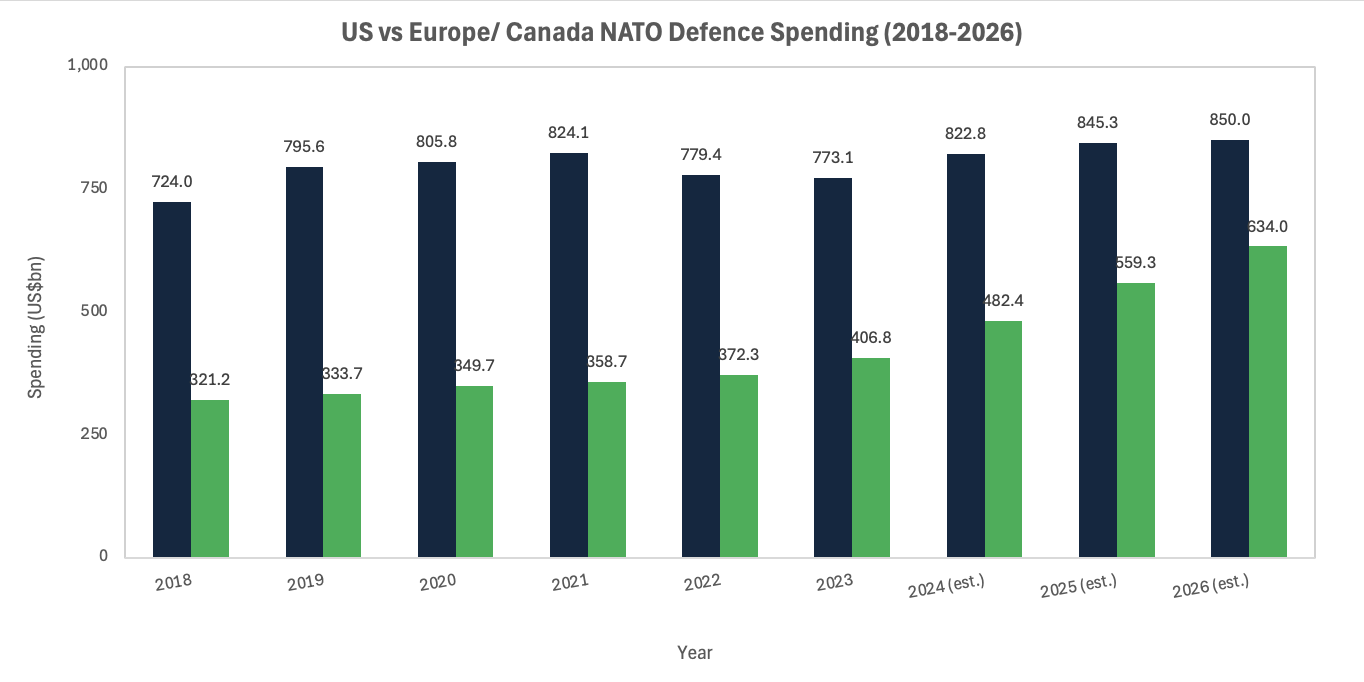
Source: NATO, Defence Expenditure of NATO Countries 2014-2025 (constant 2021 prices and exchange rates); ICDS Defence Spending: Who Is Doing What?, July 2026, for 2026 estimate.
The Non-Obvious Mechanism
The sharpest assertion here is that Germany's rejection of Palantir is not a sovereignty win for Europe, it is a fragmentation cost that the market has not yet priced. Every national exclusion of a scaled incumbent forces a bespoke, sub-scale replacement build. ChapsVision's ArgonOS, Helsing's Altra, and France's Arcadia are each solving the same underlying problem, foreign data access and model opacity, with separate capital, separate certification pathways, and no shared standard. That is expensive, and the expense falls initially on national budgets before it becomes a revenue opportunity for the winning vendors.
The second-order effect that consensus underweights: CADA's four-tier sovereignty assurance framework will, once adopted, formalise a two-speed European market. Workloads classified as sensitive will legally require EU-controlled hosting and operational control, which structurally advantages sovereign cloud operators such as SAP's S3NS and OVHcloud over US hyperscalers for a growing share of public-sector and defence-adjacent demand, irrespective of technical superiority. This is procurement engineering a market outcome that pure technology competition would not have produced on this timeline.
The point a cautious sell-side desk would not publish: Palantir's near-term commercial risk is not competitive displacement, it is regulatory exclusion at the point of national tender, which is a binary, non-negotiable loss of addressable market that no product improvement can reverse. Investors holding Palantir exposure through a generic "defence AI" thesis are underwriting a regulatory risk that sits outside the company's control and outside most analysts' base case.
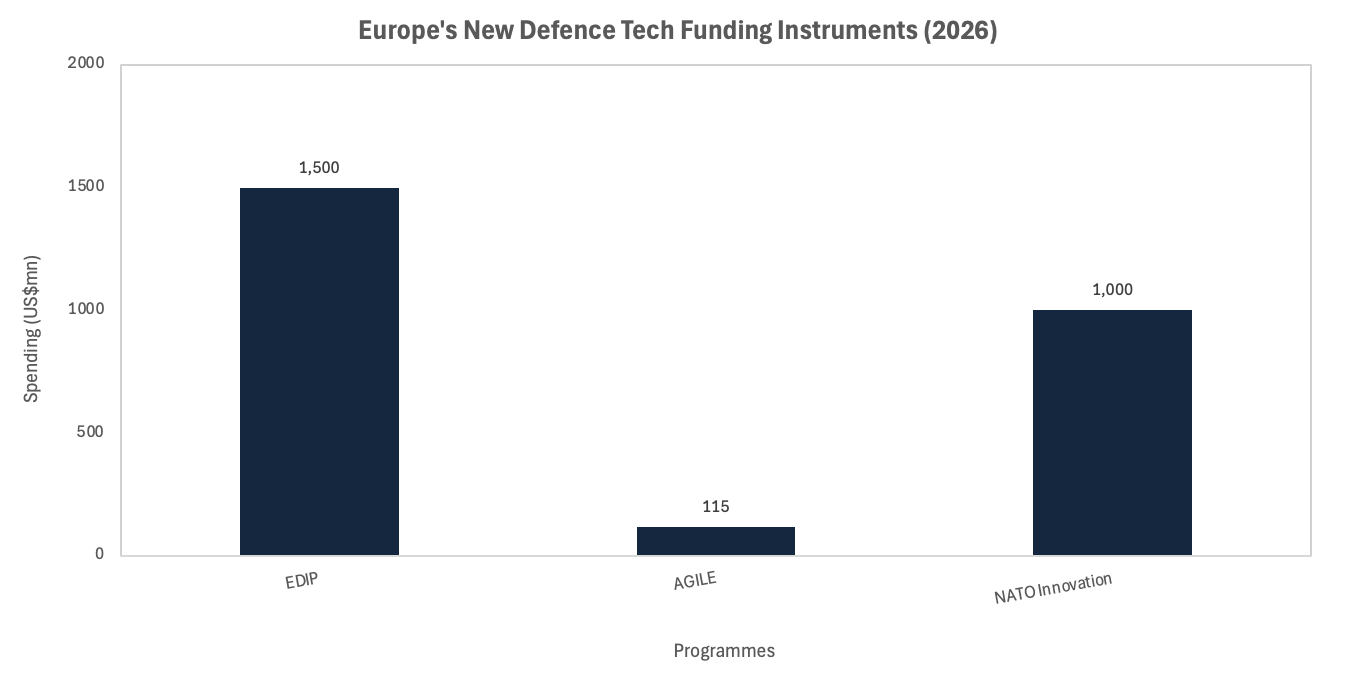
Source: European Commission; Deeptech Build defence-tech report, 31 July 2026.
What This Means for Investors
For CIOs, the binary nature of Germany's decision changes the risk framework for defence AI exposure. Holding a single-vendor thesis on US primes now carries explicit regulatory exclusion risk at the national level, even as NATO-level contracts persist. The more defensible position is a barbell: US primes for alliance-level, cross-border command systems, and a basket of European sovereign infrastructure and assurance names for the national-level replacement build, including cloud operators, and system integrators such as Helsing and SAP's sovereign cloud unit.
For portfolio managers, CADA's sovereignty assurance tiers are the mechanism to watch, not the headline spending figures. Once the four-tier framework is adopted, expected in the 2027 co-decision window, it will retroactively reclassify existing cloud and AI contracts, creating forced migration events for any provider without EU-controlled operational status. That is a catalyst with a defined, if not yet finalised, timeline, and it favours positioning ahead of the legislative outcome rather than after it.
For bankers, the deal flow is now visible in specific transactions rather than aspiration: Thales's migration of finance and procurement workloads to SAP's S3NS sovereign cloud, and the shortlisting of Atos and Helsing for the Bundeswehr's cloud programme, are templates for the recapitalisation and joint-venture structures that will recur across France, Poland, and the Nordics as national exclusion decisions multiply. [web:92] Existing defence-sector mandates, built around prime contractor equity and government bond-like revenue visibility, are not written to hold these structures, which combine private infrastructure risk with sovereign counterparty concentration.
Near-Term Catalysts and Policy Outlook
The near-term picture is one of rising regulatory certainty and falling budgetary momentum, an asymmetry that most models have not yet reconciled.
0–3 months: The European Technological Sovereignty Package enters trialogue negotiations between the Commission, Parliament, and Council, with final adoption not expected until early to mid 2027. [web:80] In parallel, NATO's Ankara summit pressed members for credible national spending plans, with the US signalling consequences for allies that fail to deliver them.
3–12 months: Germany's Bundeswehr is expected to finalise its cloud-and-AI provider shortlist among Helsing, SAP's S3NS, and Atos, a decision that will set a procurement template other member states are likely to reference. [web:92] NATO's own figures show that Europe and Canada's defence spending growth is set to slow in 2026 relative to the prior year's pace, even as the 5% GDP target for 2035 holds.
Bridging these two windows, the scenario range for institutional positioning is as follows.
Base case: CADA is adopted in amended form by mid-2027, national exclusion decisions against Palantir continue at the margin in Germany, France, and possibly Poland, and sovereign cloud and system-integrator names capture disproportionate share of the replacement build. NATO-level contracts with US vendors persist largely unaffected.
Upside: The CADA sovereignty tiers are adopted faster and with stronger binding force than currently drafted, triggering earlier forced-migration events and a re-rating of European sovereign cloud and assurance providers ahead of the 2027 timeline.
Downside: Budget growth slows further as fiscal pressure bites, as already visible in the UK's contested £15 billion defence increase, and national sovereignty projects stall for lack of funding even as the regulatory framework advances, leaving a policy-capability gap that delays the investable opportunity.
Conclusion
The structural case has hardened since the spring: Germany's rejection of Palantir at two separate national levels is a decision, not a debate, and it confirms that sovereign AI fragmentation is now embedded in procurement law and practice rather than political rhetoric. The cyclical overlay is that defence budget growth, while still rising towards the 5% GDP target, is decelerating in pace, which lengthens the timeline over which this capital rotation plays out.
The geopolitical read is straightforward: every national exclusion of a US vendor is also a data point in the wider transatlantic relationship, and it will be read in Washington as evidence that European defence spending increases are not converting proportionately into US vendor revenue, a tension that is likely to surface in trade and alliance discussions well before CADA is finalised.
The question institutional capital has not yet asked is this: once Germany, France, and the UK have each built separate sovereign alternatives to the same underlying problem, who underwrites the interoperability failure risk between three incompatible national AI stacks inside a single alliance command structure, and which balance sheet holds that liability when it materialises in an operational context rather than a procurement one?
References
Grosswald – Bundeswehr Will Not Use Palantir for Military Cloud and AI Project, European Alternatives Shortlisted – 28 April 2026
CIO Bulletin – German Intelligence Agency Rejects American Palantir Software for French ArgonOS – 15 May 2026
Financial Times – AI Is Becoming a Geopolitical Weapon, Warns EU Digital Chief – 21 July 2026
European Commission – Communication on European Tech Sovereignty, Accompanied by EU Open Source Strategy – 3 June 2026
Jones Day – EU Proposes Tech Sovereignty Package with Major Implications for Digital Markets – 9 June 2026
Reuters – NATO Defence Push Already Strains Europe's Budgets – 6 July 2026
Euractiv – Europe, Canada Defence Spending Growth Set to Slow in 2026, NATO Estimates – 7 July 2026
Defense News – France to Test Its Own AI-Powered Battlefield Command in June NATO Exercise – 6 June 2026
Gov.uk – Tech Secretary Launches Sovereign AI Fund – 16 April 2026
Disclaimer
This article is for information and discussion only and does not constitute investment advice or a recommendation.