
Cost Asymmetry and the Broken Shield: Why the 200:1 Ratio Rewrites Defence Capital Allocation
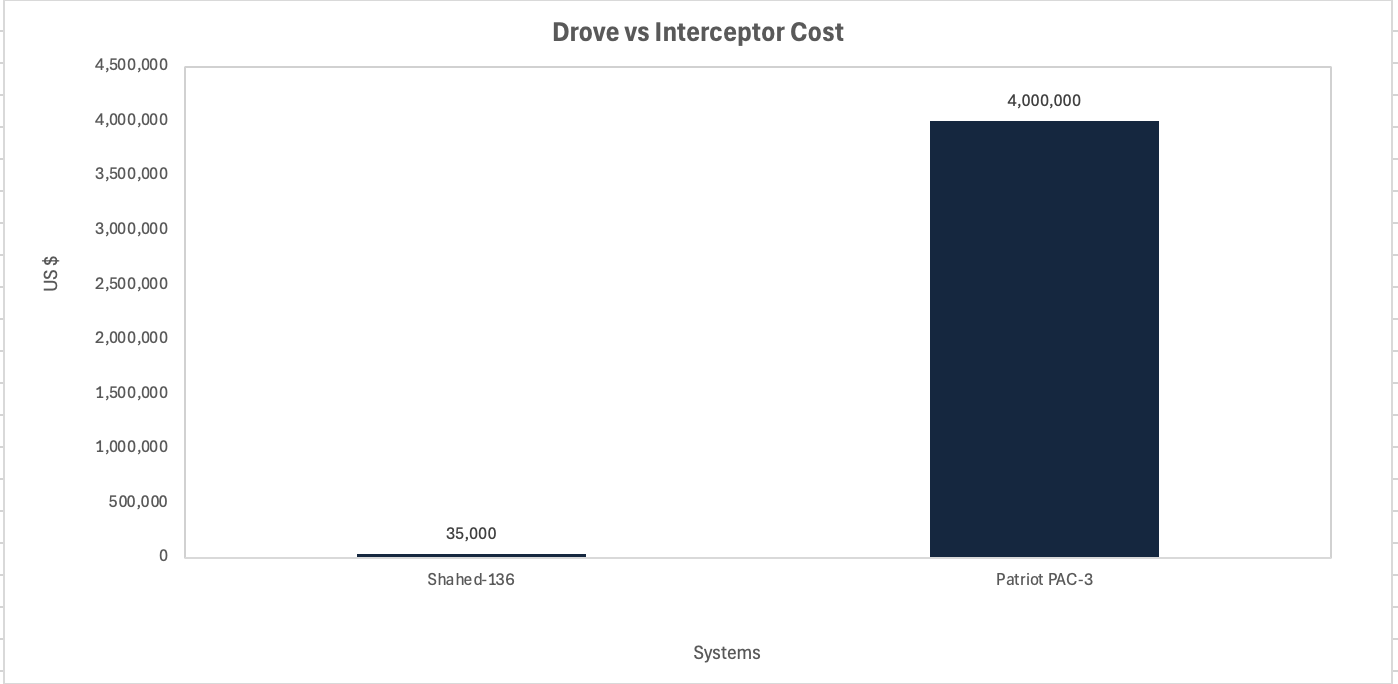
A $20,000 drone is now forcing a $4 million response. When that exchange happens at industrial scale, the procurement model does not bend, it breaks.
Western air defence was built for a symmetric threat, expensive missiles, scarce targets, long planning cycles. That model is now out of date. The modern battlefield, from Ukraine to the Middle East, is being shaped by cheap mass, rapid iteration and industrial-scale attrition, while governments are finally admitting that drones and counter-drone systems are not a niche, but a core force mix. NATO said this explicitly on 7 July 2026, committing over USD 40 billion to counter-drone capabilities over five years and promising a NATO counter-drone marketplace to speed procurement.
Why This Matters
Stockpile depletion is becoming a balance sheet issue: The UK’s Defence Investment Plan now commits more than £5 billion to drones and autonomous systems, while NATO and the Pentagon are also shifting towards mass counter-drone spending, which means defence demand is moving from one-off procurement towards repeat-purchase attributable system.
Legacy primes are exposed to product-mix risk: Budgets are still rising, but the spending mix is moving away from exquisite platforms and towards autonomous, low-cost, software-enabled systems, which is a different earnings profile and a different margin structure.
The policy signal is no longer theoretical: The UK has published named drone programmes, including Project Nyx and Project Corvus, while NATO has created a procurement pathway for counter-drone systems. That is the point at which allocation starts to move from narrative to order book.
The Core Shift
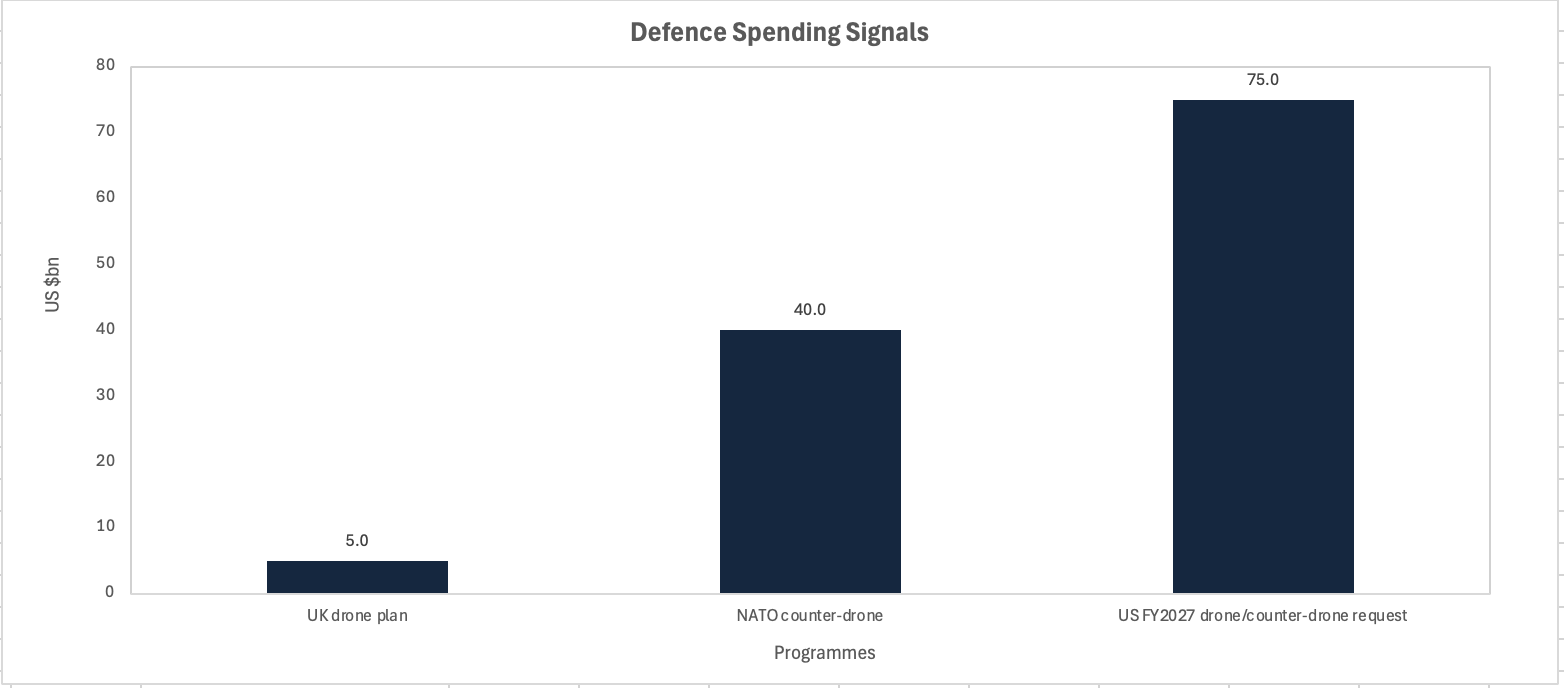
The core facts have hardened in the past six weeks. The UK announced more than £5 billion for drones and autonomous systems in its Defence Investment Plan on 29 June, describing it as the largest ever UK investment in this technology. NATO followed on 7 July with a formal declaration that drones have fundamentally altered modern warfare and that Allies will invest over USD 40 billion in counter-drone capabilities over five years. In the United States, FY2027 budget signals now point to a drone and counter-drone request of about USD 75 billion, with the Defense Autonomous Warfare Group alone seeking USD 54.6 billion.
That matters because it confirms the shift is no longer just battlefield improvisation. It has become procurement doctrine. The standard institutional read still treats this as a temporary surge in defence spending. The more likely read is that the spend is re-platforming: from large, exquisite, slow-build systems to attributable mass, autonomous sensing, and rapid software integration. Parts availability, MRO, and delivery speed are now the binding constraints, not price alone.
The reason valuations have not fully adjusted is that many investors are still analysing defence as if the old model survives. It does not. In a world where innovation cycles are measured in weeks, not years, and where Ukraine is reportedly using roughly 200,000 drones a month, the defender’s cost base no longer maps to the attacker’s.
Source: Reuters, UK Government, NATO
The Non-Obvious Mechanism
The surface story is about cheap drones. The deeper story is about procurement design. Cost-plus and long-cycle contracting reward complexity, not speed. They preserve incumbent margin pools, but they also lock defence ministries into architectures that are too slow to match the tempo of software-defined warfare. That is the mechanism breaking the old logic.
The sharpest point is this: the procurement model has become the liability. Every dollar locked into a high-specification legacy interceptor is a dollar not spent on cheaper autonomous interceptors, directed-energy systems or battlefield software that can change the exchange ratio. NATO’s new counter-drone marketplace is important precisely because it is a tacit admission that legacy procurement channels are too slow for the threat environment.
This is also where the second-order risk sits. Stockpile depletion is not just a military problem. It becomes a sovereign fiscal problem when a state has to keep buying expensive interceptors to defend against cheap mass attacks, while industrial output cannot replenish inventory fast enough. That is why the UK’s new investment plan, with named drone programmes and a taskforce to scale production, matters more than a generic budget risk.
What This Means for Investors
For CIOs and portfolio managers, the first question is not whether defence budgets are growing. They are. The question is whether the cash flow is shifting into the right product mix. Legacy primes still benefit from replenishment demand, but the longer the cost asymmetry holds, the more their backlog quality depends on systems that may be structurally over-specified for the new threat.
The beneficiaries are increasingly clear. Directed-energy and counter-drone companies sit closest to the policy signal. So do firms offering autonomous systems, sensor fusion and software that integrates battlefield data quickly enough to enable cheap interception. The UK’s commitment to a hybrid force, uncrewed systems and low-cost autonomous systems is a concrete sign that procurement is moving into this lane.
For bankers, the consequence is a widening M&A map. Tier-two and tier-three defence technology firms with autonomous, EW or counter-drone IP are more likely to become acquisition targets as primes try to reposition. That should support deal flow, but not evenly. Capital will flow first to vendors with near-term deploy-ability, domestic content and procurement compatibility. Existing fund mandates are only partly equipped to hold this exposure, because many benchmarked defence strategies remain biased to the incumbent primes, while some ESG screens still block the newer dual-use and autonomous names entirely.
Source: UK Government, FY 2027 Pentagon Reporting, NATO
Catalysts and Policy Outlook
The risk asymmetry is now skewed towards faster procurement repricing than consensus expects.
0 to 3 months: The UK Defence Investment Plan will start moving from announcement to contracting, with the Uncrewed Systems Centre and the new Uncrewed Systems Taskforce acting as early execution markers. NATO’s Drone Edge initiative will also pressure Allies to identify systems that can enter the counter-drone marketplace quickly.
3 to 12 months: The key catalyst is whether procurement authorities shift from legacy platform replenishment to faster, outcome-based contracting for counter-drone and autonomous systems. The United States’ FY2027 drone and counter-drone request is the clearest signal that this shift is already in motion, but the market impact depends on how much of the request is converted into executable budget authority.
The base case is gradual reallocation: legacy stockpile replenishment remains large, but autonomous systems gain share of spend. The upside case is a visible operational shock that forces emergency procurement reform and accelerates directed-energy and counter-drone adoption. The downside case is that budgets rise, but the contracting model stays slow, which preserves the current cost asymmetry and leaves the defender structurally disadvantaged.
Conclusion
The 200:1 cost ratio is not a tactical oddity. It is a structural indictment of a procurement system built for a different era. The cyclical reading, that higher defence budgets lift all boats, is incomplete. The structural reading is that capital is being misallocated into the wrong capabilities, and the market has not yet fully priced the shift towards attributable mass, autonomous systems and counter-drone infrastructure.
The geopolitical overlay makes this more than a sector trade. NATO has now formalised the shift, the UK has put real money behind it, and the United States is signalling a far larger drone budget than the market has been modelling. The question institutional capital still has not asked is simple: if procurement itself is the source of the mispricing, who has the mandate flexibility to reach the correction before it becomes consensus?
References
NATO – NATO’s Drone Edge – 7 July 2026
UK Government – UK drone transformation to strengthen Armed Forces backed by more than £5 billion – 29 June 2026
Reuters – UK's long-awaited defence plan allocates £5 billion to drones – 29 June 2026
Unite – 2026 Aerospace Defence Indirect Procurement – 21 July 2026
DefenseScoop – Defense industry shifts procurement model to speed drone deployment – 13 July 2026
Pentagon / FY2027 budget reporting – US defence drone procurement market and budget signal – 21 April 2026
This article is for information and discussion only and does not constitute investment advice or a recommendation.