
The autonomous weapons debate is usually framed as a legal vacuum around future systems. That read is already behind the market. The more immediate issue for institutional capital is that money is concentrating into a narrow cluster of autonomy and dual-use firms faster than any accountability framework is clarifying.
Why This Matters
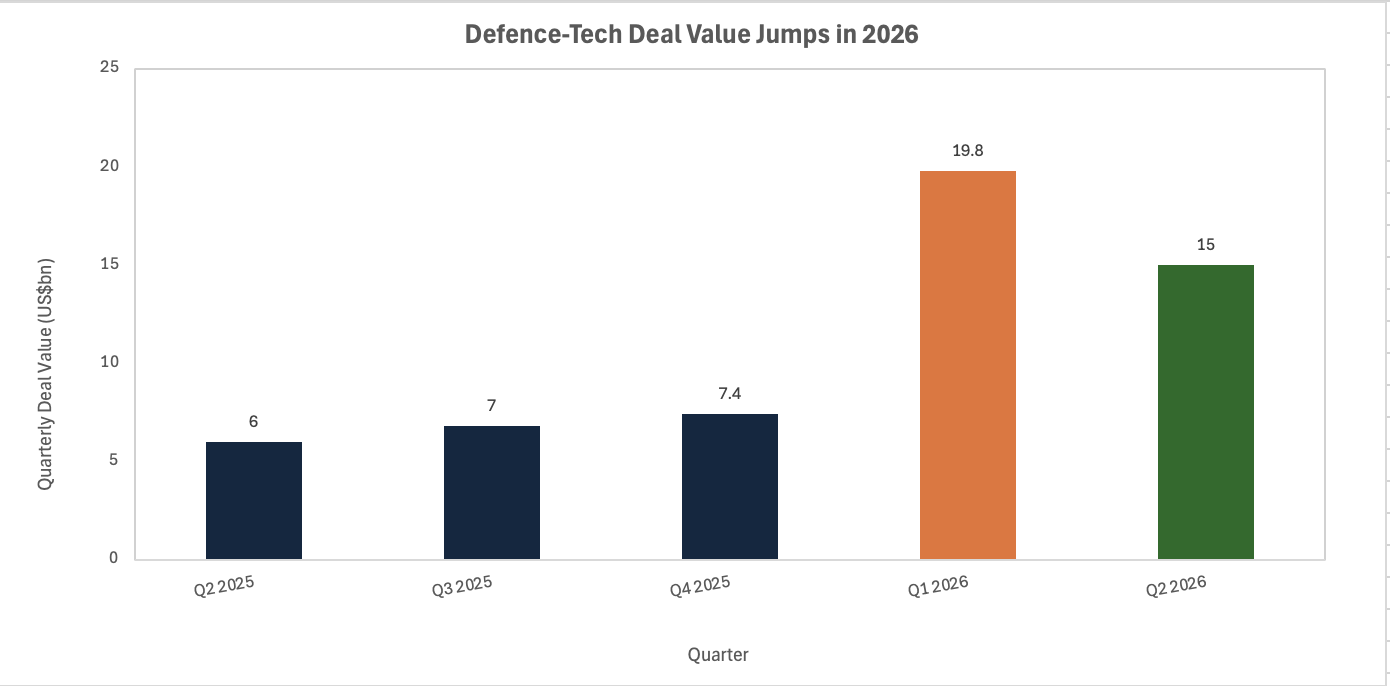
Capital concentration: Defence-tech venture capital reached $35.4 billion across 415 deals in the first half of 2026, with the 10 largest Q2 rounds capturing 62% of quarterly value.
Mandate drift: Five of the 10 largest Q2 rounds went to companies outside defence-specific segments, including Groq, Cyera, Form Energy, Helion and Cowboy Space, which means defence exposure is increasingly entering portfolios through dual-use channels rather than explicit weapons holdings.
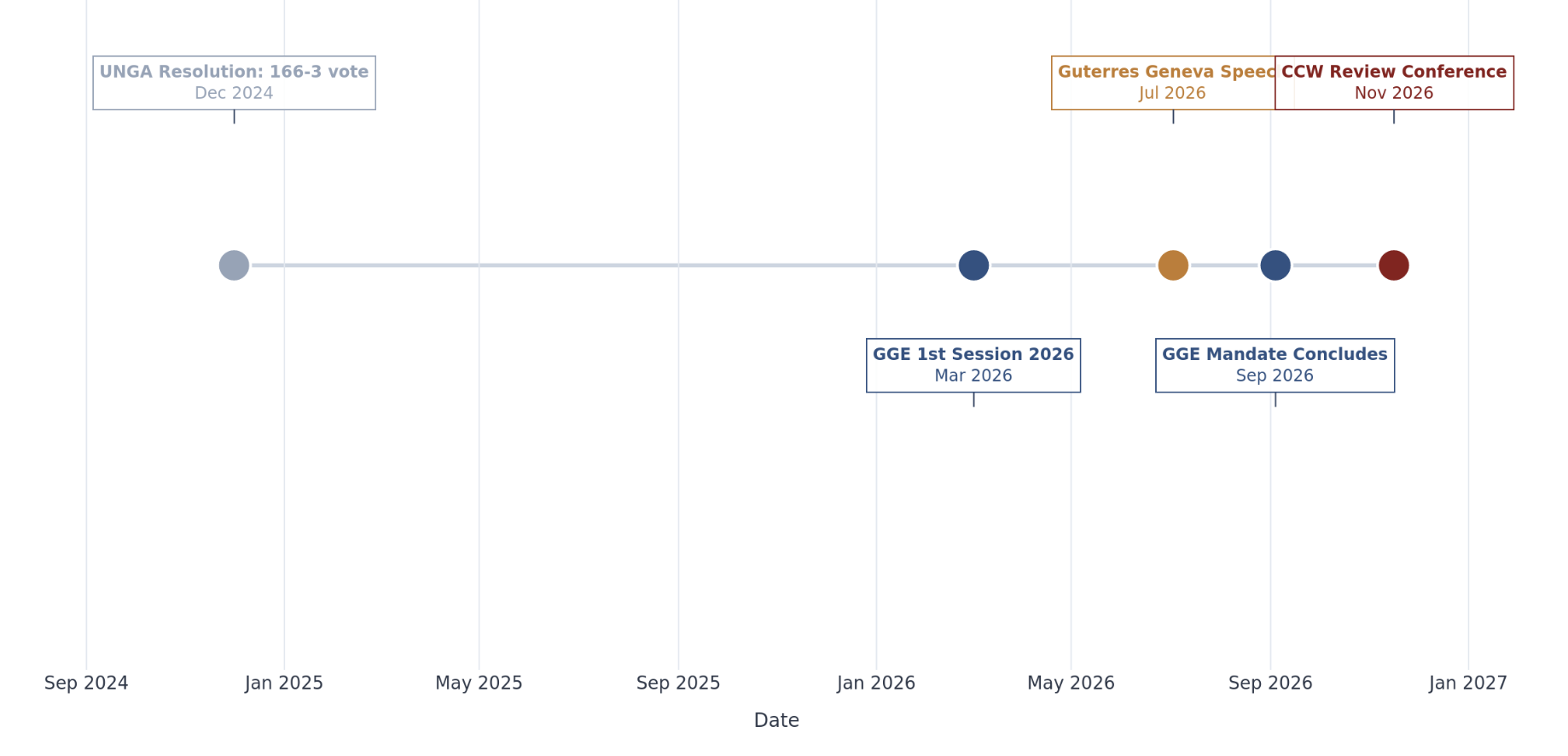
Policy compression: The next GGE session runs from 31 August to 4 September 2026, with the CCW Review Conference scheduled for 16 to 20 November 2026, which leaves only a short window for states to move from rolling text to a negotiating mandate.
The core shift
The standard institutional read treats autonomous weapons as a sector growth story with occasional regulatory noise. The lagging assumption is that legal ambiguity is a background condition rather than an active capital-market variable. That is no longer persuasive.
PitchBook’s Q2 2026 defence-tech data show that investors concentrated more dollars into fewer scaled companies, with average Q2 round size rising to roughly $91 million from about $81 million in Q1. Anduril’s $5 billion Series H alone accounted for one-third of Q2 deal value, while the 10 largest rounds represented 62% of the quarter. The market is therefore becoming narrower, more top-heavy and more sensitive to policy repricing than a broad-based thematic allocation would suggest.
This matters because no binding international treaty governs lethal autonomous weapons systems today, even though states broadly agree that international humanitarian law applies to them. The accountability gap is not theoretical. It now sits inside scaled private-market valuations and increasingly inside public-market expectations for autonomy-linked defence businesses.
The non-obvious mechanism
The sharper analytical read is not simply that there is an accountability void. It is that capital has already started to underwrite that void through dual-use growth equity before the market has agreed what kind of liability sits closest to the autonomous decision point.
That is where the article should go further than a cautious sell-side note. Five of the 10 largest Q2 rounds went to companies outside defence-specific segments. In other words, the exposure is not confined to obvious weapons manufacturers. It is moving through semiconductors, energy systems, cyber platforms and adjacent industrial technologies whose commercial narratives are broader than defence, but whose revenue trajectories and multiples are increasingly shaped by defence demand and autonomy budgets.
The more likely read is that accountability, when it comes, will not arrive first through a neat multilateral treaty. It will arrive commercially, through export licensing, procurement conditions, insurance treatment, diligence standards and investor stewardship long before a universally binding legal instrument is agreed. That makes the risk less visible to conventional ESG screens and more dangerous to mandates that still classify exposure by sector labels rather than functional capability.
What this means for investors
For CIOs, the first implication is mandate adequacy. A policy that distinguishes defence from non-defence holdings at issuer level is no longer sufficient when five of the 10 largest Q2 rounds in defence tech sit outside defence-specific segments. The issue is not only whether a fund can own weapons exposure, but whether it can identify autonomy exposure when it arrives wrapped inside energy resilience, edge compute, sensing or dual-use software.
Source: PitchBook, "Q2 2026 Defense Tech VC First Look," July 2026; S&P Global Market Intelligence, "Venture Capital Investment in Defense Tech Surges While M&A Activity Slows," March 2026.
For portfolio managers, the message is not to avoid the theme. It is to distinguish growth from concentration. H1 2026 deal value reached $35.4 billion across 415 deals, while Q2 deal count fell to 164 from 251 in Q1 even as capital remained elevated. That is a classic signal that market leadership is narrowing. The next repricing will not hit the category evenly. It will hit the firms closest to the ambiguous zone between operational autonomy, targeting support and human control.
For bankers, the consequence is already visible in the shape of the deal market. Cross-border and private transactions now have to diligence not just export controls and customer concentration, but the future treatment of systems whose functionality may later sit inside a prohibited or restricted class. Existing legal opinions can describe the absence of a binding framework. They are less well equipped to price the consequences of a future framework landing on assets financed during the vacuum.
Near-term catalysts and policy outlook
The time horizon is now measured in months, and the asymmetry still runs against complacency.
0–3 month window: The immediate marker is the second 2026 GGE session from 31 August to 4 September in Geneva. Reuters reported in March that 128 nations were participating in the process and that achieving consensus even on a non-binding document remained difficult, with Russia and the United States opposed to new legally binding instruments. That means late summer is less about final agreement than about whether states can hand the November conference a document substantive enough to justify a negotiating mandate.
3–12 month window: The Seventh CCW Review Conference, scheduled for 16 to 20 November 2026 in Geneva, is now the focal event. The International Committee of the Red Cross said in June that a detailed draft framework already exists and described the conference as a key opportunity to prevent unacceptable autonomous weapons. Human Rights Watch argued in January that states should use the rolling text as a basis for negotiations and press in November for a legally binding instrument.
Source: United Nations Office for Disarmament Affairs (UNODA), 2026 Group of Governmental Experts (GGE) on Lethal Autonomous Weapons Systems, Second Session schedule; Reuters, "Progress on Rules for Lethal Autonomous Weapons Urgently Needed, Says Chair of Geneva Talks," March 2026; International Committee of the Red Cross, "Advocacy Paper: A Key Opportunity to Prevent the Development of Unacceptable Autonomous Weapons," June 2026; Human Rights Watch, "Statement to CCW GGE Consultation on Lethal Autonomous Weapons Systems," January 2026.
Bridging those two windows, the structural case is that the market is still pricing delay more confidently than it is pricing convergence. That may prove right on treaty timing, but it does not eliminate the risk of sharper compliance lines emerging first through practice.
Base: November produces procedural progress or a renewed mandate, not a treaty. Capital concentration continues and dual-use names retain valuation support.
Upside: States agree to launch negotiations on a narrow prohibition and regulation framework, clarifying the boundary between unacceptable autonomous targeting and permissible human-supervised systems. That would favour scaled incumbents with compliance depth over earlier-stage firms built around ambiguity.
Downside: No meaningful procedural progress is made in November, but a high-profile deployment incident or domestic political response shifts practical accountability into procurement and export channels without waiting for treaty law. That is the path most likely to catch mandates off guard.
Conclusion
The autonomous weapons accountability void still matters. But the more important July 2026 update is that the void is no longer merely a legal abstraction. It is now embedded in a concentrated capital formation cycle, increasingly routed through dual-use firms and compressed against a late-2026 diplomatic calendar.
The structural case is that investors are not just under-pricing legal ambiguity. They are under-pricing how quickly that ambiguity can be translated into commercial differentiation once governments, insurers and procurement authorities start drawing practical boundaries. The question institutional capital has still not properly asked is this: which current positions look like clean dual-use growth today, but would be reclassified tomorrow as exposure to autonomous force without a mandate built to absorb that shift?
References
Reuters — "Progress on rules for lethal autonomous weapons urgently needed, says chair of Geneva talks" — March 2026
Reaching Critical Will / Women's International League for Peace and Freedom — "CCW Report, Vol. 13, No. 5" — November 2025
UNODA Meetings Portal — "Group of Governmental Experts on Lethal Autonomous Weapons Systems, 2026 Sessions" — 2026
Reaching Critical Will — "Autonomous Weapons Expert Meeting, 2026" — December 2025
International Committee of the Red Cross — "Advocacy Paper: A Key Opportunity to Prevent the Development of Unacceptable Autonomous Weapons" — June 2026
Human Rights Watch — "Statement to CCW GGE Consultation on Lethal Autonomous Weapons Systems" — January 2026
HeyDay News / UN Web TV coverage — "UN Chief Demands Ban on 'Killer Robots' as 166 Nations Back Treaty Negotiations" — July 2026
PitchBook — "Q2 2026 Defense Tech VC First Look" — July 2026
S&P Global Market Intelligence — "Venture Capital Investment in Defense Tech Surges While M&A Activity Slows" — March 2026
NODIH / Crunchbase — "Defense Tech Funding Surpasses 2025 Record at $14.6B" — June 2026
GovConFeed — "Defense Tech VC Funding Hits $14.6B in Five Months" — June 2026
PitchBook LinkedIn Summary — "Defense Tech Sees $19.1B in Q2 Deals, $28.4B in VC YTD" — August 2025