
The Convergence Trade — Why the Next Decade of Alpha Lives at the Intersection of Defence, Climate Resilience, and Critical Minerals
The convergence of defence rearmament, climate resilience, and critical minerals is not a thematic coincidence. It is a structural realignment of sovereign priorities, and the capital allocation implications are only beginning to be price.
Why This Matters
The fiscal floor has shifted: Every major economy is now deploying permanent, treaty-bound defence budgets and resilience mandates simultaneously which is not stimulus spending; it is a new cost of statehood.
The same 30–40 raw materials underpin all three agendas: Copper, lithium, cobalt, and rare earths are simultaneously critical to weapons platforms, grid storage, and flood-resilient infrastructure. Supply concentration risk is compounding, not diversifying.
Valuations have not caught up with the structural read: Markets are still pricing convergence assets as cyclical commodity plays or government-contract businesses. The more likely read is that a significant re-rating is waiting for a credible policy anchor and several are already in place.
The Core Shift
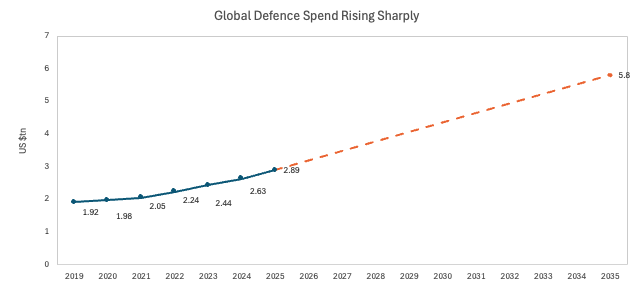
Global military expenditure reached $2.89 trillion in 2025, a 51% increase from 2019 in nominal terms, with European and Asian defence budgets driving the acceleration. At the 2025 NATO Summit in The Hague, Allies committed to 3.5% of GDP annually on core defence requirements by 2035, with up to a further 1.5% of GDP directed toward critical infrastructure protection, civil resilience, and defence-industrial base strengthening. The United States alone is targeting defence spending above $1 trillion in fiscal year 2026, a 15% year-on-year increase, driven by the One Big Beautiful Bill Act which earmarks $113 billion for 2026 alone.
Source: SIPRI 2026, IISS 2026
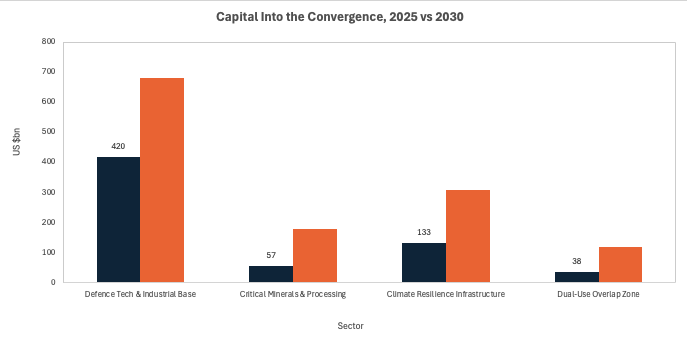
Running parallel to this, the climate resilience investment case has hardened considerably. New World Resources Institute (WRI) research estimates that every $1 invested in adaptation generates $10.50 in economic benefits over ten years, with cumulative investments studied costing over $133 billion generating $1.4 trillion in projected benefits. The critical minerals channel is no less acute: the US International Development Finance Corporation and Orion Resource Partners are finalising a $5 billion global mining fund, targeting lithium, cobalt, copper, nickel, and rare earths across direct equity, offtake arrangements, and refinery construction, a scale and speed of government-backed dealmaking with no recent precedent.
The Non-Obvious Mechanism
The conventional framing treats these three agendas as competing for the same public balance sheet. The structural case is the opposite: they require the same physical inputs, the same grid infrastructure, the same logistical networks, and the same workforce. A nation that secures its copper supply chain simultaneously strengthens its weapons manufacturing, its grid storage capacity, and its flood-resilient power infrastructure. The assets are not parallel becuase they are nested.
This nesting creates a category of investment that has no clean sector label: dual-use industrial assets that serve all three agendas simultaneously. Processing facilities for lithium and rare earths that supply both battery manufacturers and defence primes. Port infrastructure hardened against storm surge that also handles critical mineral imports. Grid-scale battery installations that provide both energy resilience and a load anchor for advanced manufacturing. The market has not yet developed a coherent framework for valuing these assets because the convergence itself is recent. Analysts covering defence do not own the ESG toolkit; ESG investors are often excluded from defence by mandate; commodity analysts treat minerals as a price-per-tonne story. The result is a valuation gap that reflects institutional siloing more than economic reality.
Investor and Stakeholder Implications
The most immediate implication is for cost of capital. Sovereign backing, whether through NATO capability targets, US export credit facilities, or European Critical Raw Materials Act (CRMA) designations is effectively lowering the risk-free floor for a defined class of projects. This does not guarantee returns, but it does change the underwriting framework: a copper processing facility with an offtake agreement tied to a defence prime and a government resilience mandate is a structurally different credit than a standalone mining asset.
Source: SIPRI 2026, WRI, Milken Institute; 2030 figures are projections
Several balance sheet implications follow. Infrastructure and private credit investors should examine which of their existing holdings contain unexplored dual-use optionality, a data centre with on-site power generation, a logistics facility at a major port, or a specialist chemical processor may already sit inside the convergence without being labelled as such. Institutional allocators with explicit defence exclusions face a harder question: an infrastructure fund investing in resilient grid assets or mineral processing is, in functional terms, participating in the same supply chain. The mandate boundary is dissolving faster than governance frameworks are updating.
Who is exposed on the downside is equally important to map. Pure-play commodity producers without processing capability or sovereign offtake arrangements remain price-takers, exposed to demand volatility and Chinese supply competition. Concentrated rare earth refining capacity remains 85–90% China-domiciled; any escalation in export controls, a policy signal, not a distant scenario as it triggers immediate cost-of-capital repricing across both defence and clean energy supply chains.
Near-Term Catalysts and Policy Outlook
The asymmetry of risks over the next twelve months skews toward upside surprise on policy commitment and downside surprise on supply chain disruption, with a narrow window in which to position ahead of re-rating.
0–3 month window: The OECD Critical Minerals Forum convened in April 2026 is producing a harmonised taxonomy for mineral security investment, which is expected to feed directly into the European CRMA's second-phase implementation. Separately, the DFC-Orion fund is reported to be in final structuring; any public announcement would function as a significant sentiment catalyst for junior miners and processing equities with US supply chain alignment.
3–12 month window: NATO member defence budgets are in active parliamentary review across Germany, Poland, and the UK. Passage of supplementary defence appropriations particularly those tied to domestic industrial base provisions will directly benefit the tier-two defence supply chain: speciality materials, electronics manufacturing, and logistics infrastructure. In parallel, the US$1 trillion+ federal defence budget for fiscal year 2026 is already creating order backlog compression across major primes, which structurally supports subcontractor and materials pricing through to late 2027.
The scenario spectrum reflects genuine uncertainty around Chinese policy response and US fiscal sustainability, both of which are live variables rather than tail risks.
Base case: Policy commitments hold, capital continues to flow into convergence assets at an accelerating rate, and the dual-use overlap zone begins to attract dedicated institutional frameworks. Critical minerals see moderate supply expansion without a major Chinese export disruption. Valuations re-rate gradually.
Upside: A Chinese rare earth export restriction mirroring the 2010 precedent but more targeted triggers emergency sovereign procurement, compressing risk premia on Western-aligned mineral assets sharply. Defence-industrial spending hits NATO pathway targets ahead of schedule.
Downside: US fiscal constraints force a sequencing of commitments; the DFC-Orion fund faces congressional scrutiny; European CRMA implementation is delayed. Capital retraces to more liquid, shorter-duration positions.
Conclusion
The convergence trade is not a theme. It is a structural consequence of three sovereign imperatives colliding around the same physical infrastructure. Defence rearmament, climate resilience, and critical minerals security all require the same copper, the same processing facilities, the same hardened grid. The market's failure to price this coherently reflects the legacy of siloed capital rather than any fundamental ambiguity about the direction of travel.
The geopolitical overlay sharpens the case. Any deterioration in US-China relations that touches trade or technology policy will function as a forced catalyst for Western supply chain investment, compressing timelines that markets are currently pricing as long-dated optionality. The structural case is that this is not a single-decade story: it is a multi-decade realignment of where sovereign capital sits, and private capital that positions ahead of the institutional re-labelling will capture the re-rating.
The cyclical read that defence spending will moderate as geopolitical tensions ease and that minerals investment will rationalise as supply expands is available and coherent. It is also, on the evidence of 2019 to 2025, consistently wrong.
Reference
SIPRI – World Military Expenditure Database – 2026
IISS – The Military Balance – 2026
NATO – Defence Expenditures and the 5% Commitment – April 2026
OECD – Fiscal and Macroeconomic Impacts of Defence Spending – March 2026
TD Economics – The Economic & Fiscal Impacts of US Defence Spending in 2026 – October 2025
World Resources Institute – The Compelling Investment Case for Climate Adaptation – March 2025
Quest Metals / DFC – US Supercharges Critical Minerals Strategy with $5 Billion Fund – November 2025
Milken Institute – Innovative Financing Models for Resilient Critical Mineral Supply Chains – September 2025
White & Case – Mining & Metals 2026: Adapting to a Policy-Driven Business Cycle – January 2026
CSIS – Critical Minerals: 2025 Year in Review & Looking Ahead to 2026 – December 2025
This article is for information and discussion only and does not constitute investment advice or a recommendation.