
Pattern-Matched to Mediocrity: What AI Hiring Tools Actually Select For
The most consequential hiring decisions companies make this decade will not be shaped by boardroom strategy. They will be shaped by a screening algorithm nobody interrogated.
Why This Matters
AI screening tools are optimised against historical hire data, which means they systematically exclude the non-linear, entrepreneurial profiles most likely to drive adaptation and growth.
With 74% of companies planning to expand AI in hiring and one in three expecting full automation by 2026, the structural risk of talent homogenisation is accelerating.
The regulatory window is closing: Colorado's Automated Decision-Making Technology framework and New York City's bias audit law are forcing disclosure and human review requirements that will expose what companies have been quietly outsourcing to machines.
The Core Shift
Artificial intelligence (AI) has moved from the periphery to the centre of the hiring funnel with remarkable speed. According to a 2025 survey by Resume.org, 79% of companies now use AI for resume review, 66% for candidate assessment, and 63% for researching applicants. One in three expect full automation of recruitment by 2026.
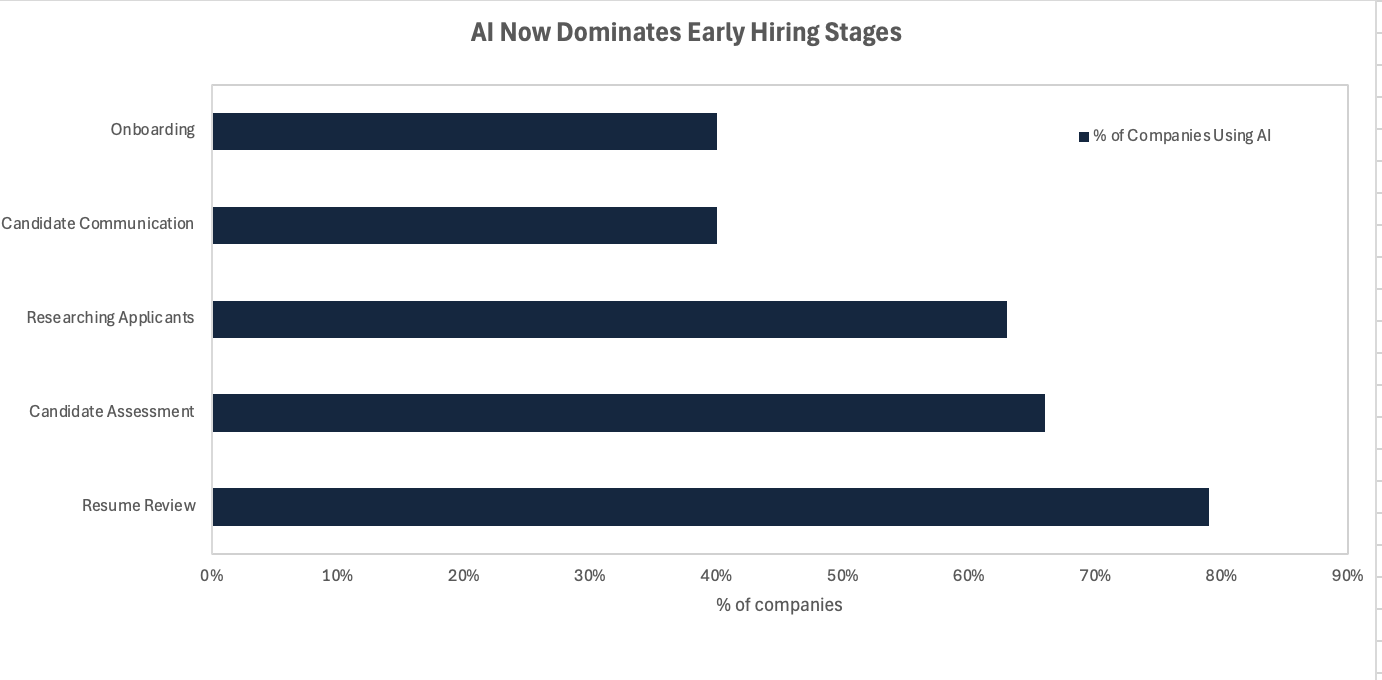
Source: Resume.org 2025 Survey
The framing from vendors is seductive: speed, consistency, bias reduction, cost savings. The reality is more uncomfortable. These systems are trained on historical hire data, which means they learn to replicate the profiles of people a company has previously hired, promoted, and retained. That is not objectivity. It is the formalisation of institutional memory, complete with every blind spot that memory contains.
A 2022 study found that 61% of AI recruitment tools trained on biased data replicated discriminatory hiring patterns. University of Washington research in 2024 found that large language models used in resume screening favoured white-associated names 85% of the time and never preferred Black male-associated names over white male-associated names. The tool is not neutral. It is a mirror held up to past decisions, and it amplifies what it reflects.
The Non-Obvious Mechanism
The bias literature has focused, understandably, on demographic discrimination. That framing is important, but it misses a second-order effect that is equally damaging and far less discussed: the systematic exclusion of high-potential candidates who simply do not match a prior archetype.
Career changers, founders returning to employment, candidates with portfolio careers, specialists who moved laterally across industries — these profiles confuse pattern-matching systems. Their CVs do not parse cleanly against job description keywords. Their trajectories do not mirror those of incumbents. The algorithm scores them low, and they never reach a human decision-maker. A Harvard Business School study found that 88% of employers acknowledge their automated systems reject qualified candidates, yet continue using them. The hidden workers literature from the same institution estimated that 27 million workers in the US alone are structurally excluded from consideration, not because they lack capability, but because they lack the right credential pattern.
The irony is acute. The candidates most likely to be filtered out — those with non-linear histories, entrepreneurial stints, multi-sector experience — are precisely the profiles that organisations claim to want as they navigate structural uncertainty. An AI system trained on the last decade of hires will not surface the talent needed for the next decade of conditions. It will surface more of the same.
Investor and Stakeholder Implications
This is not only a human resources problem. It is a capital allocation problem, and leadership teams should read it as such.
The cost of a bad hire is well-documented: the US Department of Labor estimates at least 30% of first-year salary, rising to five times annual salary for executive roles. For a senior strategic hire at $150,000, that translates to a minimum direct cost of $45,000; for an executive, the figure can reach $240,000. What is less discussed is the compounding cost of a missed hire: the non-linear candidate filtered out at the screening stage who joins a competitor instead.
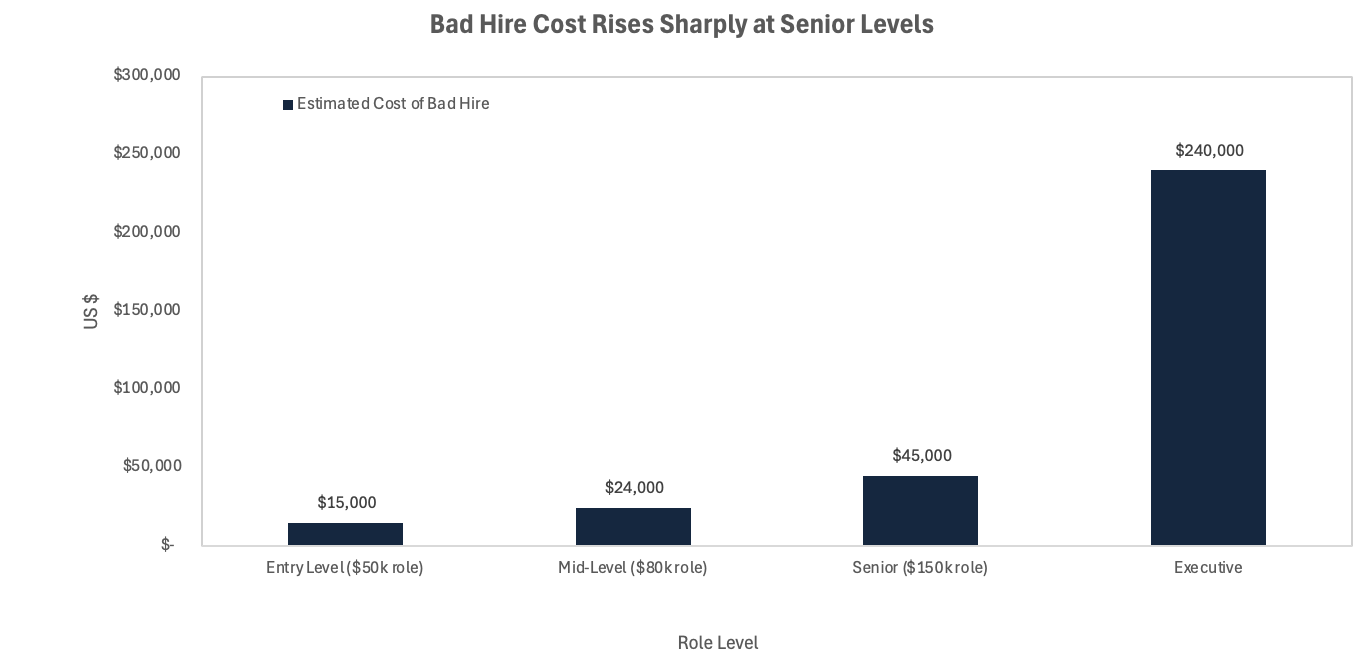
Source: US Department of Labor; Calyptus 2025
For founders and growth-stage leadership teams, the implication is direct: if you are using an off-the-shelf applicant tracking system (ATS) or AI screening layer without customising the evaluation criteria, you are likely rejecting the candidates you most need. The algorithmic funnel is calibrated for the median of your past, not the requirements of your future. Companies that rebuilding genuine human assessment capability at the early interview stage — structured competency evaluation, contextual judgement, hypothesis-based questioning — will produce materially stronger talent outcomes than those that have outsourced the entire screening layer to a black box.
Near-Term Catalysts and Policy Outlook
The regulatory landscape is tightening, and the asymmetry of risk is now weighted against inaction. Companies that have built hiring processes entirely around automated screening are accumulating both legal and reputational exposure they have not fully priced in.
0 to 3 months: New York City's Local Law 144 is already in force, requiring employers to conduct annual bias audits of automated employment decision tools and publish results publicly. Any company with New York operations using AI screening that has not completed an audit is currently non-compliant.[2]
3 to 12 months: Colorado's AI accountability framework, currently being rewritten following the 2024 Colorado Artificial Intelligence Act (CAIA), is expected to take effect by January 2027 under the proposed revision. The revised proposal strips the mandatory bias audit requirements but retains transparency and human review obligations: employers must disclose AI use to applicants, provide plain-language explanations of adverse AI-assisted decisions, and offer a meaningful right to human review by a reviewer with actual authority to override. California finalised similar regulations in October 2025 clarifying how anti-discrimination laws apply to AI hiring tools.
The more likely read is that these disclosure requirements, once operationalised, will surface the scale of automated rejection in ways that embarrass early adopters and accelerate class-action litigation. The scenario set below reflects the range of outcomes for companies currently dependent on AI-led screening:
Base case: Regulatory compliance costs increase moderately; companies begin supplementing AI screening with structured human review for senior and specialist roles; the talent quality differential between algorithm-dependent and human-led hiring processes becomes measurable over a 12 to 24-month cycle.
Upside case: Forward-looking leadership teams use the regulatory moment as a forcing function to rebuild genuine assessment capability; this produces a durable competitive advantage in talent acquisition precisely as labour markets for specialist and AI-literate roles remain tight.[10]
Downside case: Companies delay remediation, face regulatory action under multiple state frameworks, and simultaneously discover that years of pattern-matched hiring have produced leadership teams poorly equipped for structural uncertainty. The talent and reputational cost converges.
Conclusion
The sell-side view of AI in hiring is straightforwardly positive: efficiency gains, reduced time-to-hire, lower cost-per-applicant. That view is not wrong on those narrow metrics. What it consistently fails to follow to its conclusion is the strategic cost of what the efficiency gains are filtering out.
The structural case is this: companies using AI to screen are not accessing a better version of their historical talent funnel. They are compressing it, encoding past decisions as permanent criteria, and eliminating the variance that produces outlier performers. At a moment when the premium on adaptability, cross-domain thinking, and AI literacy is rising sharply, the profiles most likely to carry those capabilities are also the profiles most likely to fail an automated keyword screen.
The competitive edge in hiring is no longer in the automation of the funnel. It is in the quality of the human judgement that follows it. HR functions that rebuild that capability — structured assessment, contextual evaluation, deliberate weighting of non-linear experience — will outperform those that have fully delegated the decision to a system optimised for the past. The geopolitical and structural transitions reshaping capital allocation are generating demand for a kind of talent that has never existed at scale before. The algorithm, almost by definition, cannot recognise it.
References
University of Washington — AI tools show biases in ranking job applicants' names — October 2024
JobsPikr — Reducing Bias in AI Recruitment Strategies — 2025
Sanford Heisler Sharp — AI Bias in Hiring: Algorithmic Recruiting and Your Rights — 2025
Harvard Business School / Accenture — Hidden Workers: Untapped Talent — September 2021
VerityAI — Harvard Study: Our AI Rejects Qualified Candidates — May 2025
Resume.org — AI Hiring Survey 2026 — August 2025
BBC Worklife — AI hiring tools may be filtering out the best job applicants — February 2024
Calyptus — The Cost of a Bad Hire — August 2025
Fisher Phillips — Colorado Moves to Replace AI Law's Bias Audit Requirements — March 2026
GoCo — AI Recruitment Mistakes: Top Pitfalls and How to Avoid Them — February 2025
Disclaimer: This article is for information and discussion only and does not constitute investment advice or a recommendation.