
AI Authentication Is Quietly Repricing Art as a Financial Asset, and Most Collectors Are on the Wrong Side
The art market's next liquidity crisis will not be caused by a crash in demand; it will be caused by a collapse in verifiability.
For decades, art's value proposition rested on three pillars: rarity, taste, and trust. The first two have not changed. The third is being systematically dismantled and rebuilt by machine learning and state of the art camera screening technology. The reconstruction is not happening evenly across the market.
A new generation of artificial intelligence (AI) diagnostic tools, capable of reading a painting's physical composition with greater precision than most human experts, is doing what decades of regulatory pressure could not: making provenance a hard, testable, financially material attribute rather than a soft reputational one. The consequences for collectors, family offices, and art lenders are structural and irreversible.
Why this matters?
Collateral at risk: Outstanding art-secured loans reached a record $32 billion in 2024, approaching a projected $40 billion by end-2025. That capital is secured against assets whose verifiability is now being tested at a speed that far exceeds the due diligence infrastructure most lenders and collectors have in place.
Buyer deterrence is already measurable: 62% of high-net-worth (HNW) collectors reported in 2024 that provenance gaps had stopped them from pursuing acquisitions. AI diagnostics will accelerate this effect by making gaps impossible to paper over with expert opinion alone.
The regulatory clock is running: The European Union's (EU) Anti-Money Laundering (AML) Single Rulebook, with full application mandated for 10 July 2027, will impose standardised due diligence requirements on art market participants at scale. Collectors and family offices that have not begun provenance remediation face a compressing window.
The Diagnostic Revolution Is Already Here
The technology is no longer speculative. AI systems trained on deep learning models and image datasets exceeding one million artworks can now assess authenticity digitally, without physical transportation, and deliver encrypted analysis reports in under a week. There are companies being in operational for quite a few years and commercially available in the European market, offer peer-reviewed AI authentication already being adopted by auction houses, insurers, private banks and art advisers worldwide.
Alongside software-based authentication, non-destructive physical diagnostics have reached a new level of resolution. Techniques including Macro X-ray Fluorescence (MA-XRF), Reflectance Imaging Spectroscopy (RIS), hyperspectral imaging and Infrared Reflectography (IRR) now function as standard investigative tools in leading conservation institutions. When integrated with AI-driven data fusion, these techniques can virtually reconstruct paint stratigraphy, date pigments with precision and detect over-painting or compositional alteration invisible to the human eye. What previously required months of laboratory work can now be completed in hours.
The critical shift is not the existence of these tools but their accessibility. What was once confined to a handful of museum conservation laboratories is now commercially available, mobile and cost-effective. Institutions that understand this are building authenticated provenance into acquisitions from the moment of purchase. Those that do not are accumulating a different kind of risk: assets whose valuation assumptions were formed before the diagnostic bar was raised.
The Hidden Mechanism: Provenance as Collateral
The financial consequence of AI diagnostics is not primarily about forgery detection, though that matters. It is about how provenance verifiability is becoming a structural input into art as a financial asset, specifically across three interrelated markets: lending, insurance and secondary liquidity.
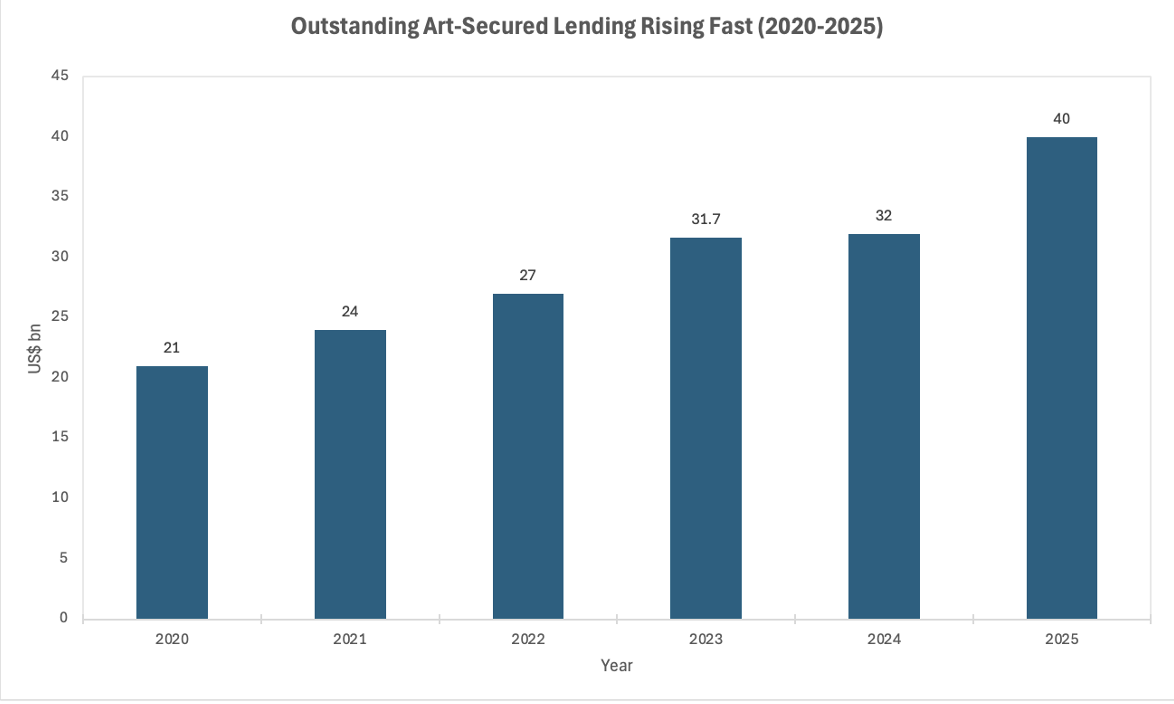
Source: Deloitte Art & Finance Report 2025; Art Basel & UBS 2025. Note: 2025 is estimted
Outstanding art-secured loans reached a record $32 billion in 2024, with the Deloitte Private and ArtTactic Art & Finance Report 2025 projecting the figure approaching $40 billion as higher interest rates drive collectors to unlock liquidity without selling. The art-secured lending market is growing at approximately 11% annually, drawing in private banks, specialised lenders and auction house financing arms.
But that credit is only as sound as the underlying collateral's verifiability. As AI diagnostics become standard due diligence within lending institutions, works without clean, digitally verifiable provenance will attract either higher loan-to-value haircuts or outright refusal as eligible collateral. The mechanism is the same as the one that repriced mortgage-backed securities when the quality of underlying assets was finally interrogated: the problem was always there; the tool to reveal it simply did not exist yet.
Insurance underwriters are moving in the same direction. A work whose physical composition, attribution and ownership chain cannot be verified against objective diagnostic data represents an open-ended liability. Premiums will adjust and coverage terms will narrow. The parallel with environmental, social and governance (ESG) risk underwriting is instructive: once a category of risk becomes measurable, the market prices it. Unmeasured risk does not disappear; it is repriced the moment measurement becomes possible.
The Bifurcation in Practice
The market is already stratifying, though the pricing signal is not yet fully visible in public auction results. Buyer behaviour in 2025 showed a pronounced concentration of demand around works with strong, institutionally backed provenance and deep exhibition history. Among HNW collectors, 74% reported conducting extensive provenance research before placing bids, and 62% had declined acquisitions specifically because of ownership gaps.
The divide runs between institutions that have invested in provenance infrastructure and those that have not. Major auction houses, top-tier galleries and the largest private banks have integrated AI-assisted authentication into their workflows. Family office collections built over decades, particularly those assembled through private transactions, estate purchases or in jurisdictions with weaker documentation standards, are disproportionately exposed. Works held in non-Western markets, or transferred through multiple private hands before the digitalisation of records, carry the greatest verification gaps.
For investors in art technology, this bifurcation represents a durable commercial opportunity. The market for AI authentication, provenance management software, digital registry services and AI-enhanced conservation diagnostics is at an early but accelerating stage. The Europe AI in Art Authentication market was identified in early 2026 as a strategic growth area, driven not by discretionary demand but by regulatory pressure, lender requirements and the secondary market's growing intolerance of unverifiable assets.
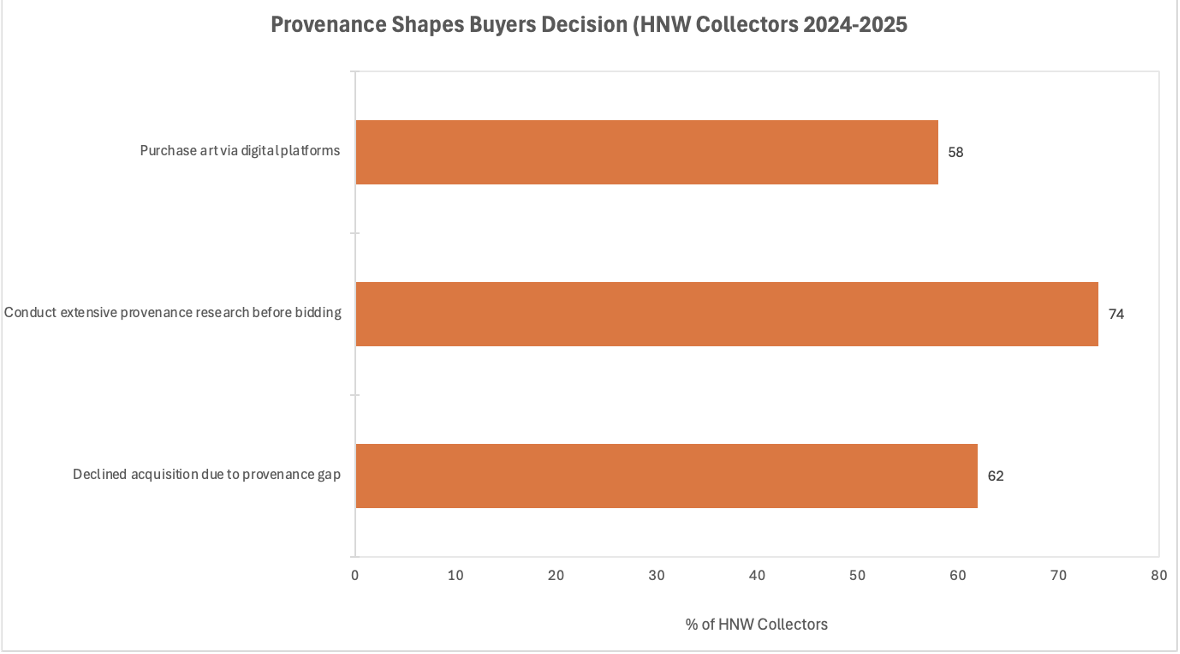
Source: Art Basel & UBS Art Market Report 2024, Morgan & Stern 2025
Regulatory Tailwinds and the Policy Clock
The EU AML package, adopted in 2024, represents the most significant structural shift in art market regulation in a generation. The Anti-Money Laundering Authority (AMLA) became fully operational on 1 January 2026, assuming all AML and counter-terrorist financing (CTF) mandates previously held by the European Banking Authority (EBA). The EU AML Single Rulebook, including Regulatory Technical Standards on customer due diligence, is due for full application from 10 July 2027. From 2028, AMLA will directly supervise 40 high-risk EU financial institutions.
Art market participants, including dealers, auction houses and advisers, are already classified as obliged entities under EU AML frameworks. As the Single Rulebook hardens and AMLA builds supervisory capacity, the practical burden of provenance verification will intensify. The effect is a rising compliance floor: institutions handling transactions above defined thresholds will be required to demonstrate documented ownership chains and, increasingly, scientific authentication. Provenance will shift from a differentiator into a threshold requirement.
The United Kingdom and United States are moving in parallel directions. The UK Money Laundering, Terrorist Financing and Transfer of Funds Regulations already capture high-value dealers. The US Treasury's Financial Crimes Enforcement Network (FinCEN) has progressively extended AML rules to the art sector. The direction of travel across all major jurisdictions is consistent: the tolerance for opacity in art transactions is narrowing, and AI diagnostics are the only scalable tool capable of meeting the verification demand that regulators are creating.
Conclusion
The consensus view frames AI authentication as a useful upgrade to a traditional market: faster, cheaper expertise. That framing is wrong and accepting it leads to a consequential misallocation of attention. AI diagnostics are not improving the existing system; they are creating the conditions for a parallel one. Provenance-verified art is becoming a distinct asset sub-class, with structurally lower cost of capital, broader lending eligibility and deeper secondary liquidity. The rest faces a compounding discount whose magnitude will become visible only when the first large portfolio of unverified works fails a lender's new due diligence standard.
The non-consensus read is this: the risk embedded in art as an asset class is not market illiquidity in the traditional sense. It is verification illiquidity, and it is concentrated in precisely the segment of the market, privately assembled, geographically dispersed, estate-derived, that family offices are most likely to hold. Remediation is neither cheap nor quick. The collectors and advisers who begin now are building a structural advantage. Those who wait for the standard to harden before acting will find that the cost of remediation has risen alongside it.
References
Art Basel & UBS – Global Art Market Report 2025
Deloitte Private & ArtTactic – Art & Finance Report 2025
Art Recognition – AI Art Authentication Engine, Microsoft Marketplace – February 2026
NautaDutilh – AMLR 2026: 3 Key Developments – January 2026
European Parliament – The Future of Anti-Money Laundering in the European Union – 2025
European Anti-Money Laundering Authority – Work Programme 2025
Nature Heritage Science – Machine Learning for Painting Conservation: A State-of-the-Art Review – September 2025
Spectroscopy Online – Nondestructive Spectral Analysis for Cultural Heritage – November 2025
Observer – Why Provenance Is Still the Art World's Blind Spot – May 2025
Morgen & Stern – Global Blue-Chip Art Market Report 2025
RICS Property Journal – Art Valuers Must Be Diligent Given Risk of Forgeries – November 2025
LinkedIn/Artwise – Closing Provenance Gaps: Strategies for Collectors – September 2025
This article is for information and discussion only and does not constitute investment advice or a recommendation.