
Less, Better, Fully Used: How Luxury Meat Becomes Sustainable
Author: Justin Kew
Meat is not the villain; the damage comes from eating too much of the wrong meat, raised badly, wasting half the animal and trashing nature and labour along the way.
A smaller volume of high‑standard, fully utilised meat can sit inside climate, biodiversity, water and human‑rights constraints in a way that anonymous, low‑cost meat cannot. Luxury meat, with its high margins, tight supply chains and demanding customers, is where this “responsible protein” model can be proven first and where future policy support and capital are most likely to concentrate.
Why this matters
Problem definition: The core sustainability problem in meat is over‑consumption, intensive low‑welfare farming, biodiversity loss, high water stress and under‑utilisation of each animal, not the existence of meat itself.
Luxury meat as proof‑point: High‑end supply chains have the margins and control to show that meat can be bred, fed and processed under strong climate, nature, water and labour standards, with near‑full carcass utilisation.
Policy and capital alignment: As support moves from volume to “public goods”, systems that deliver lower emissions, protect ecosystems and water, and respect workers are better placed to retain public backing and attract long‑term capital.
What is changing
Climate, biodiversity and health research now converge on a clear message. The current global meat consumption and production patterns are incompatible with environmental limits, but this does not imply that all meat must disappear. Livestock drives a large share of agricultural greenhouse gas emissions, land‑use pressure and deforestation, especially through beef and soy for feed, yet moderate intake from better systems can be compatible with environmental and health goals if total volumes fall and standards rise.
Land and biodiversity impacts are central. Food systems are a major driver of terrestrial biodiversity loss, and global meat demand is tightly linked to conversion of grasslands, savannas and forests into pasture and cropland. Analyses show that if the world adopted a more plant‑rich diet, large areas of pasture and cropland could be restored, with significant gains for biodiversity and carbon storage. Within current systems, however, there is a spectrum: some livestock models exacerbate deforestation and habitat loss, while others maintain existing grasslands and avoid expansion into high‑biodiversity areas.
Water follows a similar pattern. Beef has a relatively high-water footprint, but most of this is green water (rainfall stored in soil). The real stress arises when feed depends on irrigation (blue water) and when manure and fertilisers pollute rivers and aquifers (grey water). Studies of English beef and lamb and broader cattle systems find that carefully managed grazing and better nutrient management can reduce local water stress and improve water‑use efficiency. Again, the issue is not that cattle drink, but where and how the system interacts with scarce freshwater and pollution loads.
Human rights are increasingly recognised as inseparable from animal agriculture’s footprint. Industrial livestock and meatpacking sectors have a documented record of poor labour conditions, including low pay, high injury rates, excessive hours, exploitation of migrants and weak union protections. Investigations in Europe and North America have highlighted violations of fundamental workers’ rights on farms and in slaughterhouses, reinforcing the view that “bad meat” often bundles together environmental harm and human exploitation.
Against this backdrop, agricultural policy is shifting. Institutions such as the FAO and the European Commission are moving from generic livestock support towards sustainable livestock frameworks that incorporate greenhouse gases, land and biodiversity, water, animal welfare and social aspects. This does not imply an agenda of abolishing all meat; it is about transforming production systems and encouraging “less but better” consumption.
Chart 1 – Why bad systems, not meat per se, drive the damage
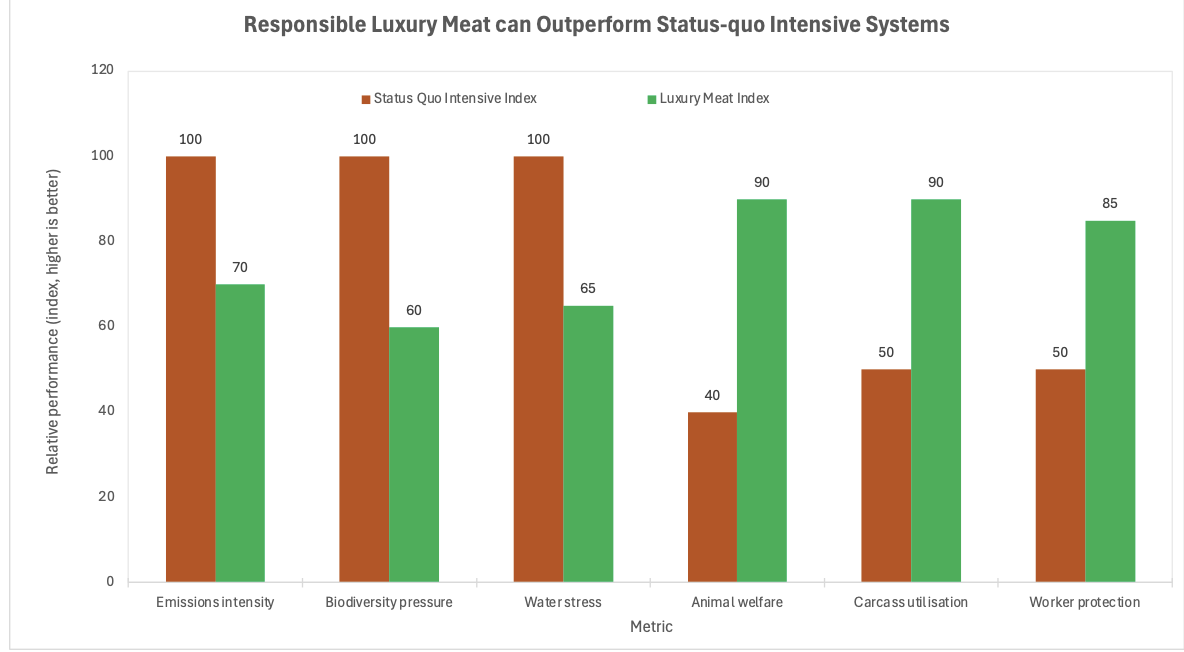
Better feed, land management, water practices, welfare, carcass utilisation and labour standards mean well‑designed luxury meat systems can materially reduce key impacts relative to intensive models.
Source: Synthesis of sustainable livestock, biodiversity, water and labour literature.
The non‑obvious mechanism: luxury meat as responsible‑protein laboratory
The intuitive view is that luxury meat will be first in line for taxes and subsidy cuts because it is emissions‑intensive and discretionary. The more important dynamic is that it is also the segment best equipped to show that meat consumption can be reconciled with climate, biodiversity, water and human‑rights constraints if done differently.
Luxury meat supply chains have three structural advantages.
Margins: they can absorb the cost of better feed, housing, welfare, traceability, labour standards and water treatment in a way low‑margin producers cannot.
Control: supply chains are typically more integrated, with clearer visibility from farm to plate, making it feasible to set and enforce standards on land use, feed origins, water management and labour. T
Customers: affluent consumers and high‑end buyers are more willing to pay for provenance, welfare, environmental performance and labour ethics, creating demand‑side support for higher standards.
Those characteristics allow luxury systems to deliver four core features of responsible meat:
Fewer animals, better feed: Improving feed conversion ratios and animal health, using more regionally appropriate, lower‑deforestation feed, and managing manure to cut emissions per kilogram and reduce local pollution.
Nature‑aligned land use: Avoiding new conversion of forests and high‑biodiversity areas, managing existing grasslands and savannas in ways that support biodiversity and soil health, and integrating animals into broader agro‑ecological systems where possible.
Water‑smart production: Leaning on rainfed (green) water where possible, improving irrigation efficiency where used, and investing in nutrient management and treatment to reduce grey‑water impacts.
Whole‑animal and whole‑chain responsibility: Maximising carcass utilisation and co‑products, and upgrading labour conditions through formal contracts, health and safety measures, and respect for worker rights.
Once such systems are proven commercially viable, they become the template regulators and buyers can use: future support, procurement and finance can be tied to quantifiable gains in emissions intensity, deforestation risk, biodiversity impacts, water stress, welfare and labour standards. Luxury meat is where these cross‑cutting conditions can be piloted with the least disruption to calorie security.
What investors are missing
Investor narratives often stop at “meat bad, plants good”, overlooking critical intra‑sector differentiation. Things to worth considering as inventors when looking at meat processing
Volume versus intensity: Climate and nature risk are functions of total animal numbers, land conversion and local water stress, not the existence of a small volume of premium meat in high‑income diets. A high‑end system that achieves lower emissions per unit of value, protects existing ecosystems and improves water and labour practices is on a different trajectory from a high‑volume, low‑standard commodity producer.
Waste and under‑utilisation: Large fractions of each animal are often discarded or down‑valued, meaning more animals are reared than necessary to meet demand for protein and other animal‑derived products. Integrated processors that systematically monetise offal and co‑products – for example into pet food or functional ingredients – increase economic and nutritional output per animal, which directly improves emissions, land and water indicators per unit of value.
Biodiversity and water location risk: Not all beef or lamb carries the same nature or water footprint. Systems linked to frontier deforestation or water‑stressed basins face much higher transition, reputational and physical risk than those operating in regions with stable grasslands, lower water stress and strong governance. Supply chains that can demonstrate low‑risk geographies and practices should not be priced as if they share the same deforestation and water profile as the worst actors.
Labour as a core risk: Meat‑packing and intensive farming labour abuses create legal, financial and brand risk, as well as operational fragility. Upside from investing in safer, better‑paid, more formal jobs is rarely priced, yet it reduces the risk of outages, litigation and reputational hits.
The variant view is that luxury meat is likely to split into responsible luxury meat and status‑quo luxury meat. The former will have a credible claim on policy support and premium demand; the latter will carry many of the same structural risks as low‑cost commodity meat. Treating them as identical exposures risks mispricing both downside and upside.
Why this matters now
Several catalysts compress the timeline.
Net‑zero and nature‑positive targets are moving into implementation: Governments and corporates are adding land, biodiversity and water targets to climate plans. Food systems – especially beef, lamb and dairy – are in focus. Blanket restrictions on all meat are politically and socially hard; incentivising and scaling responsible systems, starting with the segment most able to adjust, is more realistic.
Diet and health narratives are converging on “less but better”: Major reviews emphasise that substituting a significant share of animal products with plant‑based foods cuts emissions and health risks, but also highlight that remaining meat consumption should be lower in volume and higher in quality and standards.
Biodiversity and deforestation regulation is tightening: New due‑diligence rules and deforestation‑free supply‑chain expectations increase scrutiny of meat and feed supply chains, especially those linked to vulnerable biomes such as the Amazon and Cerrado. Luxury supply chains can more easily redirect to low‑risk regions and certify compliance.
Investor and civil‑society pressure on labour is rising: NGOs and specialist initiatives document labour abuses in animal agriculture and call for integrated approaches that consider animals, workers and communities together. That strengthens the case for integrated “social and environmental” standards in meat supply chains.
In combination, these factors make it unlikely that high‑impact, low‑standard meat systems will retain unconditional support or easy access to capital. Luxury meat that can demonstrate system‑level improvements is better placed to navigate this tightening environment.
Policy outlook: support for better systems, not blanket bans
Policy work on sustainable livestock increasingly stresses transformation, not abolition. The FAO frames sustainable livestock as economically viable, socially responsible and environmentally sound, with particular emphasis on improved governance, nature‑based solutions and resilience. European policy briefs call for ending harmful subsidies to intensive animal farming, while supporting farmers to transition towards agro‑ecological, higher‑welfare, lower‑density systems.
Emerging frameworks include several recurring elements:
Conditional payments: Public funds contingent on practices that reduce emissions, protect ecosystems and water, improve welfare and respect labour rights.
Nature‑positive land use: Incentives for maintaining or restoring grasslands and avoiding deforestation and conversion of high‑biodiversity ecosystems.
Water stewardship: Encouragement of green‑water‑aligned grazing, improved irrigation efficiency and nutrient management to reduce water stress and pollution.
Just transition for farmers and workers: Support schemes that recognise adjustment costs for producers and the need for better labour standards along the chain.
Luxury meat supply chains that align with these priorities, lower emissions intensity, deforestation‑free, water‑responsible, high‑welfare, high‑utilisation and labour‑safe – are natural candidates for future eco‑schemes, sustainability‑linked rural development support and preferential treatment in public procurement. Status‑quo luxury systems that cannot demonstrate progress are more likely to be treated as pure private luxuries, with minimal public support and higher exposure to future levies.
Sector, supply‑chain and asset‑level implications
For investors, the key shift is from a binary “meat vs plant” view to a systems‑based view within meat.
Upstream, herds bred and managed for efficient feed conversion, lower emissions, disease control and welfare – on land that is not driving deforestation or high water stress – should see more stable access to support and premium markets. Producers relying on frontier expansion, high stocking densities and feed from vulnerable biomes face higher transition and stranded‑asset risk.
Midstream, integrated processors that maximise carcass utilisation and co‑products, invest in water treatment and nutrient management, and formalise labour conditions will be better placed to meet multi‑dimensional standards from policymakers, retailers, hospitality and lenders. Their cash flows are supported by more products per animal and by eligibility for sustainability‑linked finance and contracts.
Downstream, retailers, restaurants and brands are embedding climate, deforestation‑free, animal welfare, water and labour criteria into procurement. Their luxury meat offerings are likely to concentrate in supply chains that can prove performance on all these fronts. That suggests a bifurcation within premium meat: some assets become “responsible luxury” with durable demand and policy backing; others become structurally exposed to future restrictions and reputational risk.
Chart 2: Impact of “less, better, fully used” meat
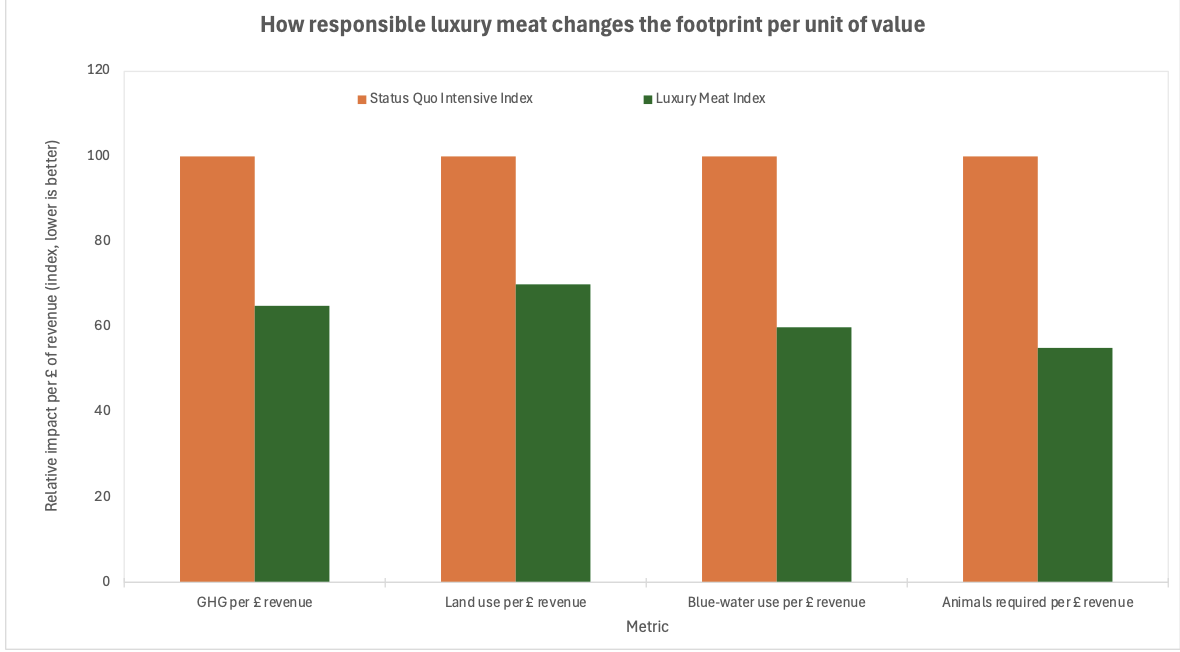
By improving feed efficiency, avoiding deforestation, managing water better and maximising carcass utilisation, responsible luxury meat can deliver the same revenue with fewer animals, lower emissions, less land and reduced blue‑water stress.
Source: Synthesis of literature on emissions, land, water and utilisation in livestock systems.
From a capital‑allocation perspective, the investable meat story is not about avoiding meat altogether, but about backing systems that use fewer animals, more efficiently and humanely, per unit of value – and that protect ecosystems, water and workers in the process.
Conclusion: there is nothing wrong with meat – if we demand better
The non‑consensus takeaway is that there is nothing inherently wrong with eating meat; the real problem is eating too much of the wrong meat, raised badly, half wasted and built on degraded ecosystems, stressed water and exploited labour. If consumers move towards less frequent, higher‑standard meat and policymakers reward systems that deliver better feed conversion, biodiversity and water outcomes, full‑carcass utilisation, welfare and labour standards, luxury meat can become a cornerstone of responsible protein rather than a symbol of excess. Structurally, future support and capital will follow production systems, not slogans – and luxury meat is where the tests, standards and early winners will emerge first.
This article is for information and discussion only and does not constitute investment advice or a recommendation.
References
FAO – Sustainable Livestock: Policy Support and Governance – 2024
European Commission – Keeping Livestock Systems Healthy, Sustainable and Resilient – 2025
Our World in Data – Land Use: If the World Adopted a Plant‑Based Diet – 2021
Our World in Data – What Are the Trade‑Offs Between Animal Welfare and the Environmental Impact of Meat? – 2024
Our World in Data / Food Systems Dashboard – Greenhouse Gas Emissions Intensity for Beef – 2023
MDPI (Nutrients) – Meat Consumption, Sustainability and Alternatives: An Overview of Current Research – 2023
Biosphere Sustainable – Towards a More Sustainable Meat Consumption – 2024
Green Queen – The Climate Change–Animal Welfare Tradeoff: Just Eat Less Meat – 2024
UBC – Environmental Impact of Meat Consumption – 2023
White Rose – Sustainability and Meat Consumption: Impacts for Human Health, Animal Welfare and Environment – 2015
Nature Communications – Impacts of the Global Food System on Terrestrial Biodiversity – 2024
ScienceDirect – Impacts of Global Food Systems on Biodiversity and Water – 2019
Earth.org – How Animal Agriculture Is Accelerating Global Deforestation – 2024
FAIRR – Deforestation Risks in Animal Agriculture – 2023
Trase – Global Meat Consumption Linked to Cerrado Biodiversity Risks – 2020
AHDB – Water Footprinting English Beef and Lamb – 2010
Water Calculator – The Water Footprint of Beef: Industrial vs Pasture‑Raised – 2022
NutriNews – The Water Footprint Within the Cattle Industry – 2023
Minerva Foods – Water Efficiency in Livestock Production: Sustainability as a Strategy – 2026
WRI – Does “Better” Meat Exist? It’s Complicated – 2024
Pasture for Life – Sustainable Farming and Agriculture Practices – 2025
Compassion in World Farming – Putting the EU Livestock Sector on a Path to Sustainability: Policy Briefing – 2023
ALDF – Industrial Animal Agriculture: Exploiting Workers and Animals – 2021
Business & Human Rights Resource Centre – Workers’ Rights Allegedly Violated on Farms – 2023
The Humane League – Why The Humane League Stands for Animals and Workers Exploited by Meat Industry – 2020